2026 Digital Printing Industry Trends: Personalization Becomes the Standard
Explore the core trends in the global digital printing industry in 2026, and understand why personalized, small-batch, and high-precision custom printing have become mainstream. Learn how this trend impacts commercial and industrial printing businesses.

In 2026, the global digital printing industry reached a pivotal turning point, fundamentally breaking away from traditional printing models reliant on large-volume, fixed-template production. Driven by evolving consumer demands and continuous technological innovation, personalized custom printing has emerged as the core mainstream trend, propelling high-quality development across both commercial and industrial printing sectors.
Traditional printing is limited by plate-making processes, high setup costs, and long production cycles, making it suitable only for large-volume standardized orders. In contrast, modern digital printing requires no plates, supports variable data printing and on-demand production, perfectly meeting the market demand for small batches, diverse styles, and rapid iteration. Industry data shows that personalized digital printing orders have grown rapidly in recent years, covering diverse application scenarios such as packaging labels, product stickers, marketing materials, and customized gifts.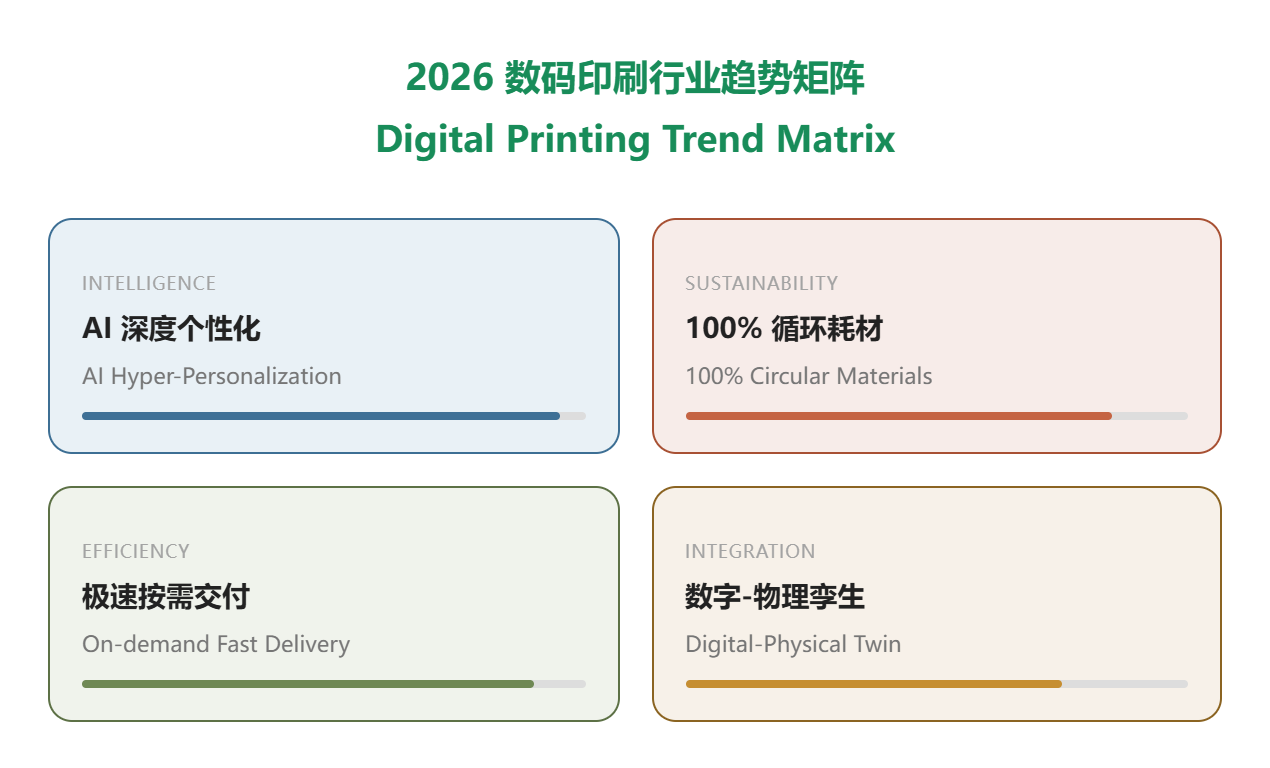
In 2026, personalized customization has shifted from a niche need to a standard for corporate brand operations. Industries such as food, cosmetics, retail, e-commerce, and cultural creativity all require differentiated printed products to boost brand competitiveness. Brands prefer flexible short-run printing solutions to avoid inventory pressure from large-scale fixed production, enabling real-time updates to packaging and label designs that align with market trends. Variable data printing of graphics, text, and QR codes also supports precise marketing.
Technological advances are accelerating the adoption of custom printing. Next-generation industrial digital printers deliver high-precision color reproduction, multi-media compatibility, and reliable continuous operation, enabling custom printing on coated paper, glossy stock, waterproof synthetic materials, and specialized substrates. Meanwhile, intelligent systems automate layout, offer one-click parameter adjustment, and support batch variable printing—significantly lowering technical barriers and reducing time costs for personalized customization.
For B2B printing equipment suppliers and global distributors, capitalizing on the trend of personalization is key to breaking into new markets. High-performance digital printers that support multi-scenario customization, rapid prototyping, and low-cost small-batch production have become the core criteria for enterprise procurement. The future of the digital printing industry will continue to evolve toward intelligence, environmental sustainability, and high levels of customization, with on-demand personalization becoming the long-term mainstream direction.